Predicting regulatory variation from personal genomes
Can deep-learning models predict how one person's DNA changes gene activity, and does that help predict Parkinson's disease? A large-scale test on 190 personal genomes.
- Kind
- Research
- Context
- MSc thesis, Aerts Lab, KU Leuven
- Result
- Spearman up to 0.89 at cohort level, but below r = 0.10 per donor: a clear, quantified limit of today's models.
- Built with
- Python, PyTorch, Scooby, CREsted, scikit-learn, HPC, Single-cell multiome
- Status
- Code private (lab data)
The question
Sequence-to-function models are deep-learning models that predict what a stretch of DNA does, such as how active a gene is or how open the chromatin is, from the sequence alone. They perform well on the reference genome. They are rarely tested on what personalised medicine actually needs: do they capture the differences between individual people?
My thesis asked three questions:
- Do the models predict the differences between genomic regions, averaged over a cohort?
- Do they predict how each donor's own variants shift that activity?
- Are those personal predictions useful for telling Parkinson's patients from controls?
The work was part of the Aerts Lab's ASAP research, supervised by Prof. Yves Moreau and Prof. Stein Aerts.
Data and models
The cohort has 190 donors with a full genome and single-cell measurements of gene activity and chromatin accessibility, from two brain regions: the cingulate cortex and the substantia nigra. 75 donors had Parkinson's disease, 115 were controls, spread over three biobanks.
I evaluated two state-of-the-art models:
- Scooby predicts gene expression per cell type from 524 kb of DNA.
- CREsted predicts chromatin accessibility per cell type from 2 kb windows.
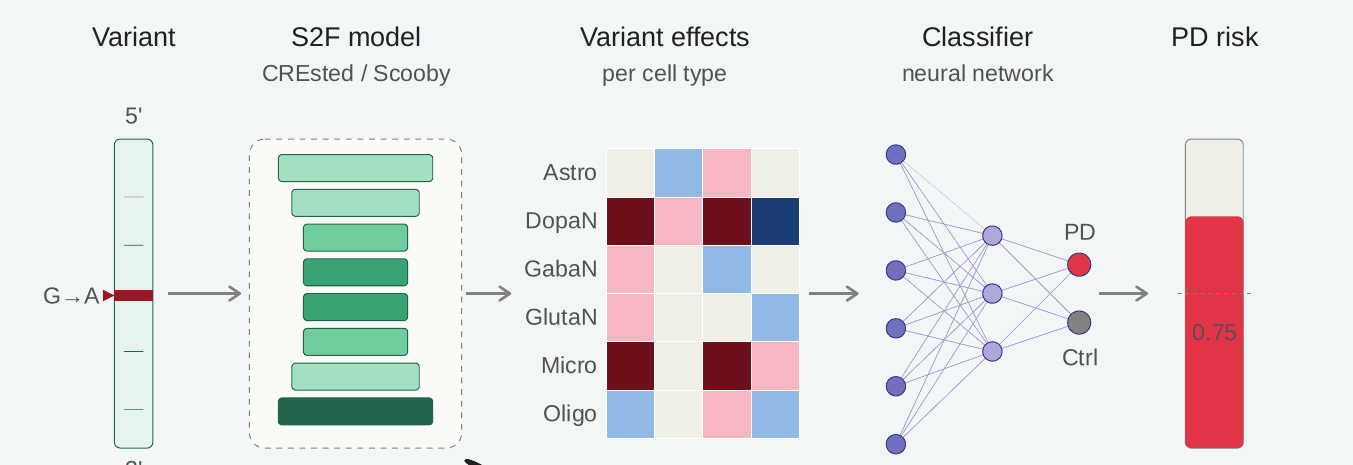
The full pipeline, from one DNA variant to a Parkinson’s risk score. From my thesis poster.
What I built
- Personal genomes. A pipeline that writes each donor's own variants into the reference sequence, per haplotype, so the models see that person's DNA instead of the reference.
- Inference at scale. Both models run for every donor, region and cell type on the Flemish Supercomputer Centre's HPC cluster: more than 200 GPU hours.
- A three-level evaluation: cohort, donor and disease. At donor level, I used block-bootstrap confidence intervals, because donors and neighbouring regions are not independent.
- A careful disease test. Classifiers that separate Parkinson's from control on the model predictions, with checks for leakage through the biobank a donor came from and for age effects.
Findings
The models get the cohort average right, but the signal almost disappears per donor.
That limits the disease test. Classifiers trained on the model predictions stayed at chance, while the measured data did carry signal:
| Classifier input | AUC (0.50 = chance) |
|---|---|
| Model predictions, all models and regions | 0.47–0.58 |
| Measured gene expression, substantia nigra | 0.79 |
| Measured chromatin, substantia nigra | 0.69 |
| Measured chromatin, cingulate cortex | 0.55 |
Even the measured data needs care. One biobank contains only controls, and a classifier can recognise that biobank from the real data with an AUC above 0.90. Part of the apparent Parkinson's signal is really a cohort effect.
What I took from it
Sequence-to-function models capture something real at population level, but the effect of a single person's variants is small compared with the biological and technical noise from other sources. Progress on this task will likely depend more on the scale, balance and quality of the cohorts than on a new architecture.
I wrote the thesis in Dutch and graduated cum laude.